
Adapted from a feature that first appeared in August 2025 on Londonist: Time Machine, our much-praised history newsletter. To be the first to read new history features like this, sign up for free here.
They say you should always look up in London. But not too far. Leave the rooftops for the pigeons and chimneysweeps. Instead, cast your eyes to the first floor (second if you’re American). Here you’ll find a neglected, orthogonal catalogue of shop signs clamouring for attention on the high street.
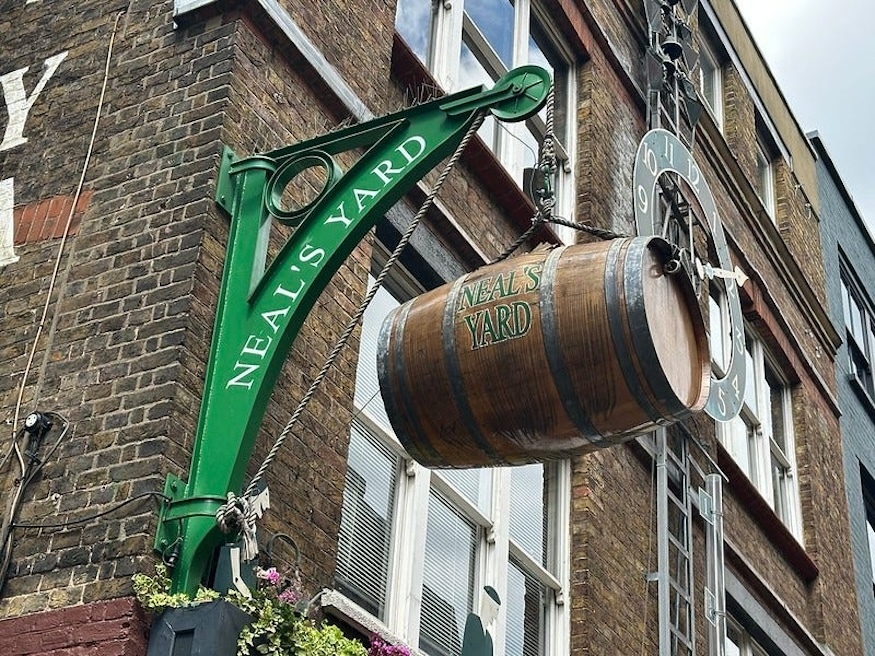
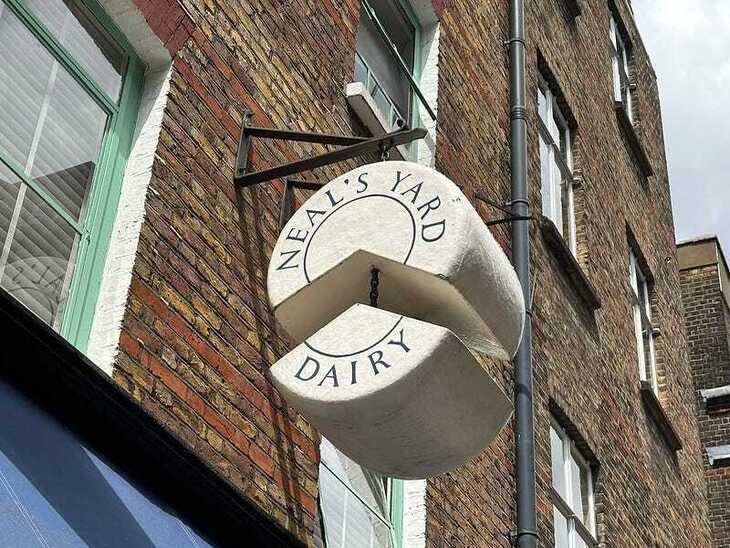
Most of today’s signs are humdrum. Every Pret, Poundland and Paddy Power has its perpendicular glowing herald, thrusting out from the brickwork. They’re little more than eye-clutter. Occasionally, though, you’ll find an individualistic gem, like this cheesy pendant in Seven Dials:
The dominion of the hanging sign has always been bossed by pubs. Their flapping nameplates remain one of the visual joys of London, even if many characterful pub signs have been lost or blandified in recent years. Here, I can’t help intruding on the text-flow to share a few of my favourite pub signs from around London:
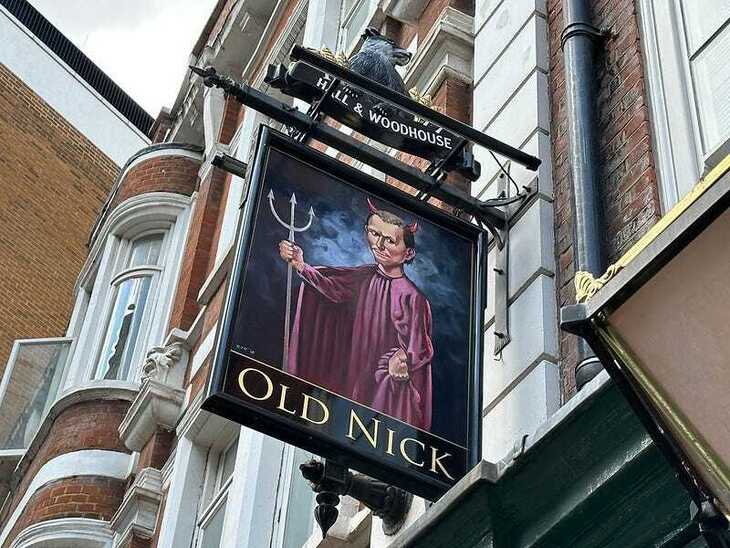
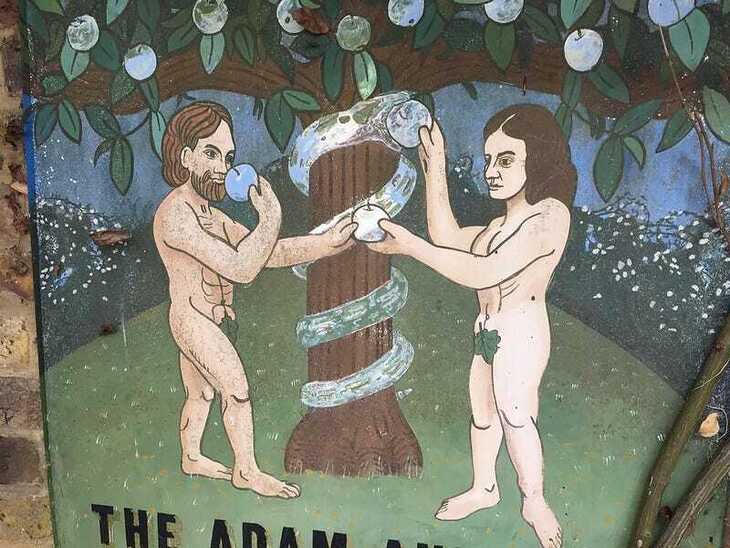
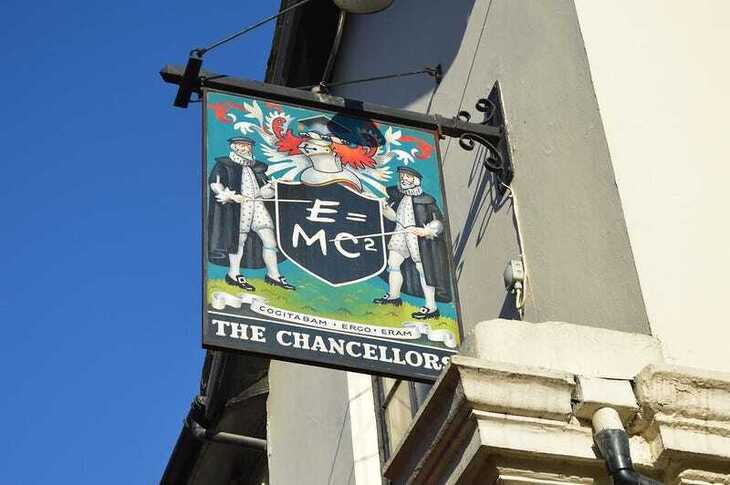
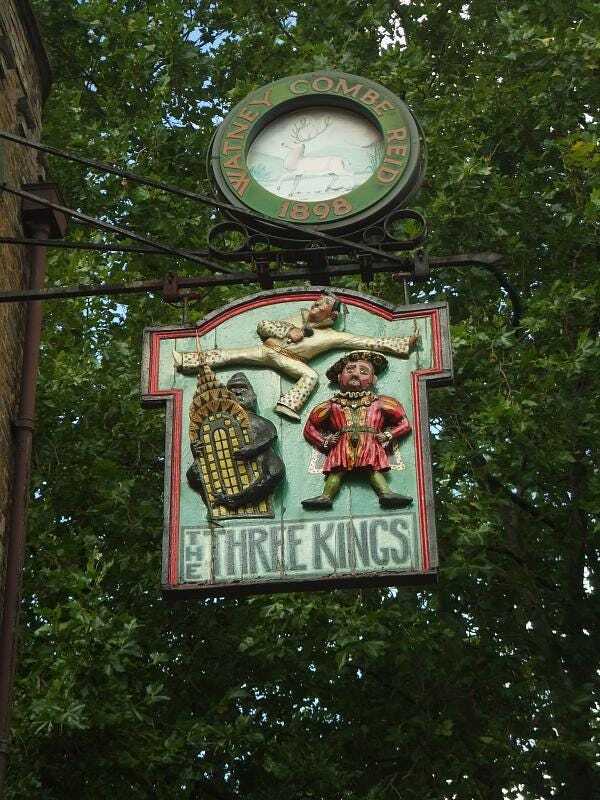
Hanging signs can rise to immortality. Many of the evocatively named passageways of London take their names from lost pubs, which in turn were named for the images on their hanging signs. Witness Hanging Sword Alley off Fleet Street, or Hen and Chickens Court, or Magpie Alley, all in the same area. In the case of Elephant and Castle, an old pub sign eventually denominated a whole neighbourhood.
Creative hanging signs today are nowhere near as ubiquitous as once was the case. Traditionally, almost every business of quality had its own, unique sign. This was a necessity at a time when most of the population could not read. Pictorial identifiers were easy to spot, and could be reproduced on business cards. Find me at the Crown and Three Sugar Loaves, you might say to your illiterate buddy. Or, as Gandalf tells the hobbits, “I’ll be waiting for you at the Inn of the Prancing Pony.” I don’t think that was London, though.
Hanging signs have been around forever, usually marking taverns. But they got a fillip during the reign of Charles I, who commended them “for the better finding out such citizens’ dwellings, shops, pubs or occupations, without impediment, molestation, or interruption to their heirs or successors.”
Thereafter, businesses of all types began to adopt signs. These might occasionally bear some relation to the trade carried on within: a bunch of grapes for a wine shop, for example, or a golden boot for a shoemaker. More often than not, though, the sign had only cryptic relevance, or none at all. Signs were often passed down to succeeding tenants, who might not carry on the same trade as the previous occupant. Sometimes, a merger could precipitate a fresh sign, with unusual combinations like the Sheep and Dolphin, or the Bell and Neat’s Tongue. (I recall a pub in Greenwich, long gone, called the Frog and Radiator… though that is clearly of more recent vintage.)
The practice of decorating your shop front with an imaginative hanging sign seems to have withered in the 18th century for a number of reasons; and one of those reasons was numbers. Door numbers. They began to creep in around mid-century as a more rational means of identifying properties. The population was also becoming more literate, so the old pictograms were now merely charming rather than necessary.
Hanging signs could also be dangerous. In 1718, a sign came loose on Fleet Street, bringing down a fair amount of brickwork with it. Two young ladies, the king’s jeweller and cobbler were supposedly killed by the falling masonry. That, at least, is the story regularly repeated in books and websites. It may well be true, although I’ve been unable to find an account of this disaster written before 1810, almost 100 years after it purportedly happened.
After incidents like that, the decline and fall of the hanging sign was inevitable as well as literal. An Act of Parliament in 1762 called for the withdrawal of hanging signs on the grounds that they were dangerous. From that point on, shop signs were supposed to be fixed parallel to the wall, rather than cantilevered out over passing heads. I don’t think this was rigorously enforced for long, however, as a quick scan of old photographs and drawings confirms.
If you seek classic hanging signs today, head to Lombard Street in the Square Mile. This features a sequence of evocative signs, none more photogenic than this auric grasshopper:
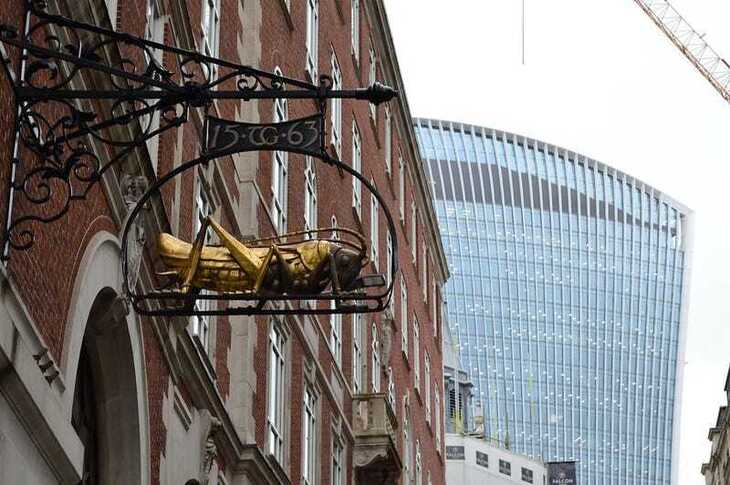
The grasshopper, as any Londonophile will know, was the personal sigil of Thomas Gresham (you can see his initials on the hanging sign). This wealthy Tudor banker founded the Royal Exchange (above which another grasshopper presides) and set up Gresham College in his will. He also maintained a goldsmiths on Lombard Street from 1563, hence the date on the sign.
Is the sign itself that old? Does it predate the Great Fire?
Sadly, I don’t think so. A newspaper article of 1844 notes that the building had a grasshopper sign “as late as 1795, until the erection of the present building, when it disappeared”. A similar tale of absence is told in the Illustrated London News of 13 June 1857. For most of the 19th century, then, there was no grasshopper dangling over Lombard Street.
The first clue that the grasshopper had returned comes from an 1892 account which states that the insect is “the sign which still decorates Martin’s Bank”. My reading is that the original sign was long vanished, and Martin’s Bank hung a replica in the late 1880s… though, of course, it’s possible they found the original in storage.
Lombard Street contains more dangle-treasures than this superannuated grasshopper. Further signs depict a fiddling cat, a golden anchor and a king’s head.
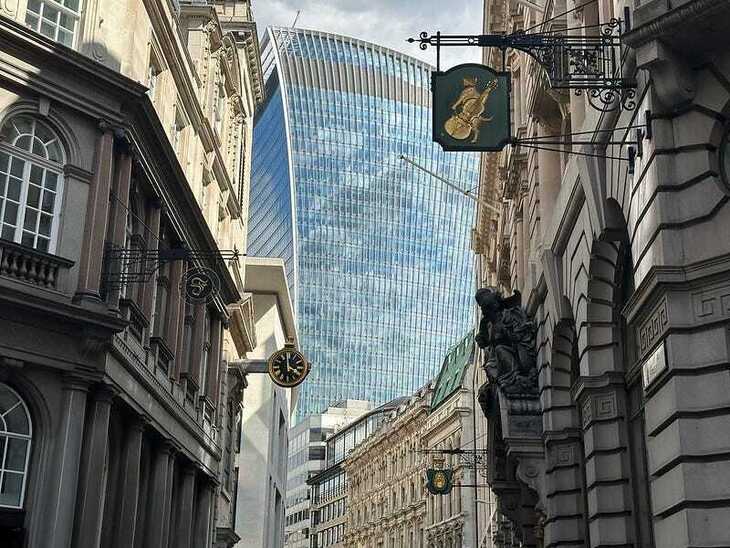
These also look proper ancient but, in fact, they’re 20th century pastiche. 23 mock-Georgian signs were placed here in 1902 as part of the celebrations for King Edward VII’s Coronation procession, as a “unique and historical” decoration. This street had a long association with hanging signs. It was here, for example, that the black horse still used by Lloyd’s Bank has its genesis. It originally hung over a goldsmiths — a popular trade on Lombard Street — but made a suitable rebus for Barnett’s, Hoares & Co. Bank who took over the building. Lloyd’s absorbed this bank in 1884 and appropriated the sign.
Lombard Street’s traditional signs had mostly vanished by 1902, but local banker and antiquarian Frederick George Hilton Price hit upon the idea of reviving them as a “unique and historical” decoration for the King’s big day. His book The Signs of Old Lombard Street provides many details about the signs, including the pastiche ones he helped to erect. These are listed below:
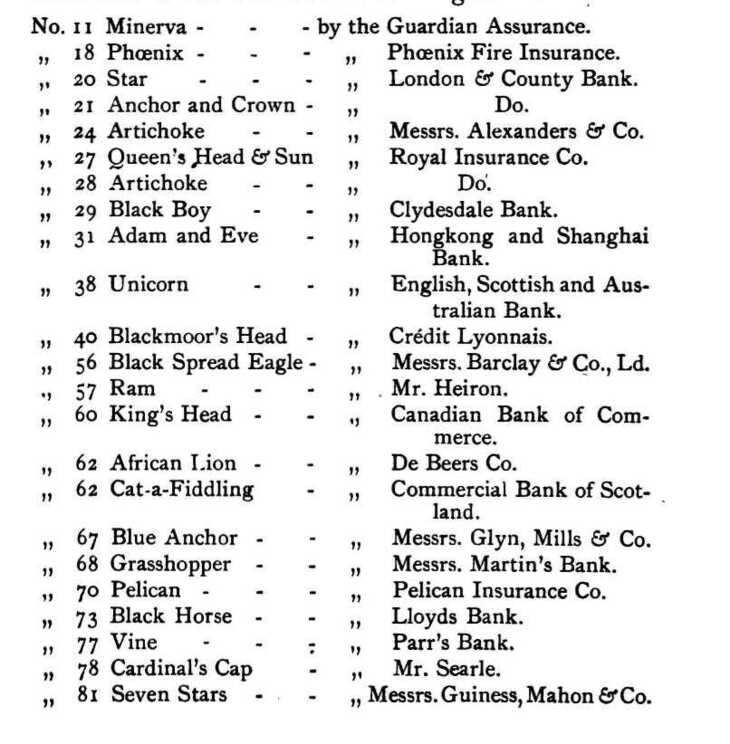
As you can see, the Grasshopper is listed among them. This was one of the few signs that was not pastiche, though as mentioned above, this iteration had only been on show for a decade or two.
Sadly, the signs were only considered temporary and the Corporation of London took most of them down the following year. Now only four remain. Perhaps we should bring them back again. I’ll add it to my list of ideas for the Great Exhibition of London of 2051… which I hope to be around to see.
In truth, I think hanging signs are making a modest comeback. I’ve noticed a rise in imaginative signs of late, including a hanging typewriter in Shoreditch, a pendant bulldog at Two Temple Place (indicating the Bulldog Trust charity), and this menacing set-up on the Lord Napier pub in Hackney Wick:
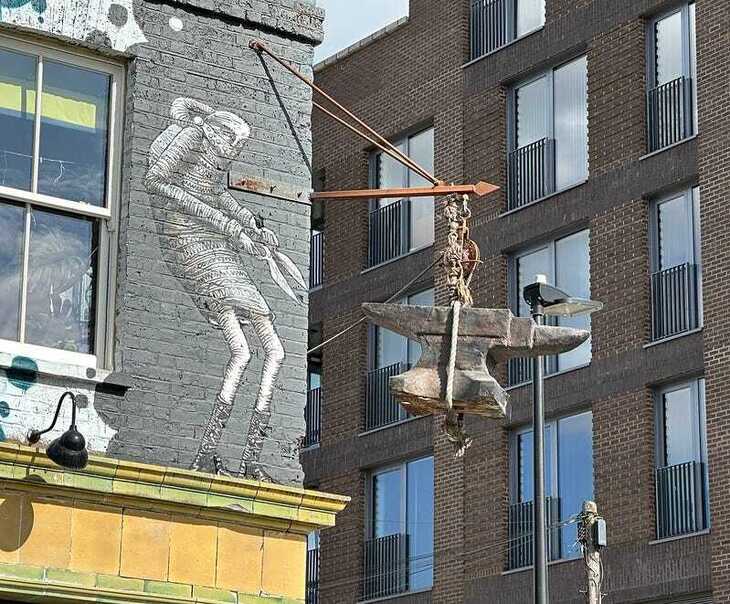
Meanwhile, Camden High Street has long been famous for its giant fibreglass signs. Doc Martens, Chinese dragons, anthropomorphic fruit and women of negligible clothing all lean out from the brick terraces.
And then we have the Dog and Pot sign on Blackfriars Road. This is a replica, installed about a decade ago, of a sign Dickens recalled seeing here as a 12-year-old in the 1820s.
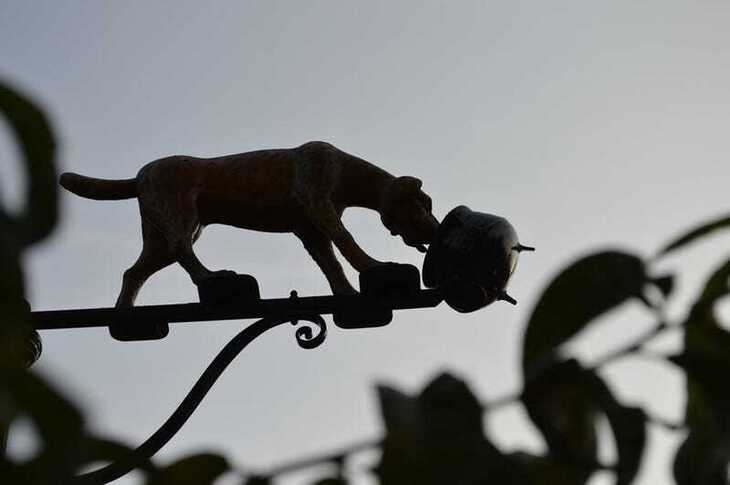
As the resurgence of the hanging sign gathers momentum, we should remember that they can still constitute a public nuisance. ⬇️ This is the Duke of York in Fitzrovia ⬇️ — the pub where Anthony Burgess was once mugged, in an incident that inspired the Droogs in his A Clockwork Orange. Until recently, its hanging sign depicted another character of dubious quality:
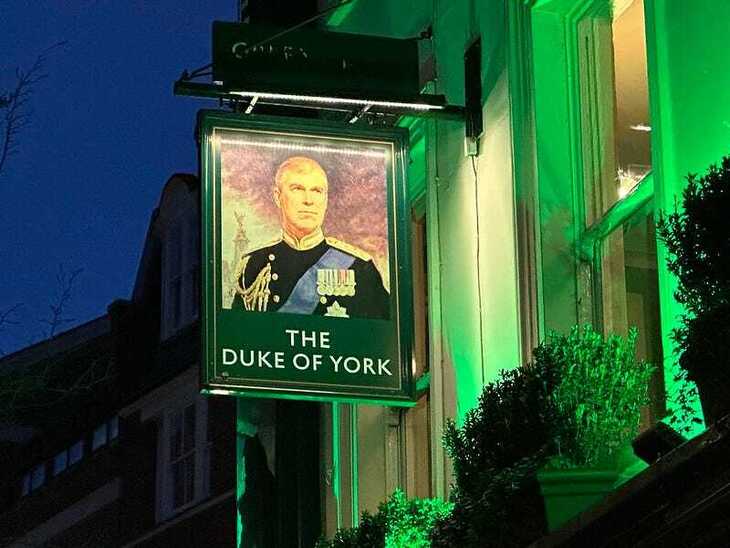
The Duke of York recently stopped swinging. The sign was removed in early 2025. The pub has new owners who are not willing to trade under their predecessor’s sign. And thereby hangs a tale.