

The new London Museum has been jointly funded by the Greater London Authority, the City of London Corporation and private donors
Sir Sadiq Khan has suggested City Hall is open to spending funds generated from the incoming overnight visitor levy to boost the capital’s cultural scene, and keep museums free.
The Mayor of London said he was speaking to museums and other stakeholders to work out the best way to distribute the money – and suggested that income generated from the tax could partly be used to prop up any struggling institutions.
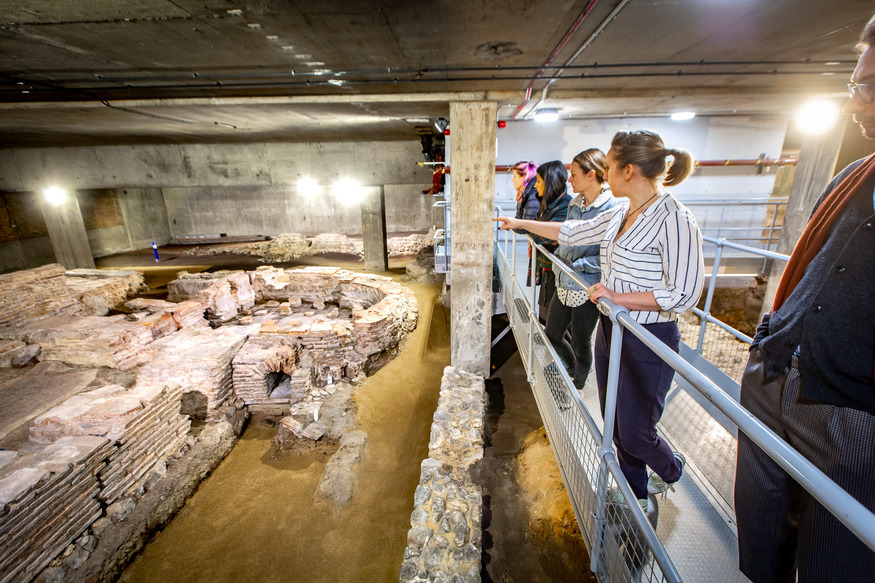
He was speaking at the new London Museum – a landmark Smithfield development jointly funded by the Greater London Authority, the City of London Corporation and private donors.
Set to open on Saturday (November 28), Sir Sadiq also hinted the funding model behind the new museum – which promises to “uncover London’s hidden stories and unexpected treasures” – could provide a blueprint for the city’s cultural scene going forward.
Keeping London’s museums free
The Mayor of London told the Local Democracy Reporting Service (LDRS) that a portion of revenue raised from the incoming overnight visitor levy – a fee of up to five per cent added to overnight stays for non-Londoners, expected to be introduced in 2028 – could be used to help keep the capital’s museums free.
Rising operating costs and lower-than-expected visitor numbers have prompted concerns about the future of museums, with industry leaders describing the current climate as “very challenging”.
“This levy is a game-changer for us,” he said.
“We’re going to do what other cities across the globe have done – from Paris to New York, from Venice to Toronto – which is to ask visitors to our city to pay just a tiny bit more to help us improve the experience.
“We’re currently speaking to museums, galleries, boroughs, those in hospitality, and others to work with us to design a scheme that’s fit for purpose, to work together about how we collect the revenues, but also to work together [on] how we spend the revenues as well.
“We’re speaking to all key partners to make sure we get the right scheme in place and also we allocate any monies raised in a sensible way. This is to be value-added rather than to replace or replenish monies that are lost.”
Chris Hayward, Policy Chairman of the City of London Corporation, told the LDRS that he will be pushing City Hall for further cultural funding.
“It’s a point we will make to the Mayor, obviously, that the levy needs to be shared across London, and we hope the Mayor will do that,” he said. “It’s really important that when we raise these sorts of funds from the public, that they can be shared across not just the City [of London], but the 32 boroughs as well. It’s a real opportunity.”
In September museum bosses warned that proposals to charge overseas tourists to visit London’s museums could harm the capital’s cultural appeal and put institutions at risk. V&A Director Tristam Hunt called for 50 per cent of any cultural element of the funding pot to be directed towards free-entry national institutions.
The Mayor of London has consistently opposed any such measure, saying that free museums and galleries were a “fundamental” part of London life.
Free admission has been in place since 2001 at the UK’s 15 national museums, including 12 in London, for both domestic and foreign visitors.
Last month, the Department for Culture, Media and Sport (DCMS) confirmed that free admission would remain in place for everyone, with ministers suggesting that fees would “deter” overseas visitors.
Sharon Ament, the Director of the London Museum, said that they currently have to rely on a “really different economic model” compared to paid-for museums, and plan to rent out retail shops on the site as well as raise funds through the gift shop and cafe.
She told the LDRS: “Our economic mix has changed. That’s really important, and that enables us to earn more self-generated income to contribute more to the ongoing costs of the museum.
“Grant-in-aid [from the GLA and City of London] is always really important, and that enables us to be fundamentally free, but our self-generated income really needs to supplement that. We want to stand on our own two feet.”
Boosting London’s cultural scene
Sir Sadiq also vowed to continue partnering closely with boroughs to boost London’s cultural scene – and didn’t rule out another similar collaboration in future with another local authority.
“We work with all boroughs, [including] through the Borough of Culture – a partnership we’ve got with the boroughs across London,” the Mayor of London told the LDRS at an exclusive press preview of the museum.
“The first one was Waltham Forest – the next one’s going to be Haringey. We work closely with boroughs in terms of Creative Enterprise Zones.
“Partnerships is what it’s all about, whether it’s museums, whether it’s galleries, whether it’s jobs, whether it’s working together. I’ve worked really hard with all 32 boroughs and the Corporation over the last 10 years. That’s going to carry on.
“Not only is it the largest city museum in the world, it’s a good example of a partnership between the City of London Corporation and City Hall.
“We’ve both invested record sums in this museum with the support of private donors. Why? Because, you know, we need great spaces like this to educate ourselves about the past, to celebrate the past, but also look to the future as well.
The Mayor noted that this particular site was “special” due to the “amount of money involved” and the “historically important” location – though he did not rule out another similar collaboration in future, should conditions allow.
Stay up to date about London’s hottest events, latest restaurant openings, and best deals with our Going Out Out newsletter. Sign up HERE!